How to Stop Inner Chamfer Tool Chipping by Opening Up Chip Clearance Behind the Chuck saving $1,037
ROI is unusually high because the declared investment is very small compared with the monthly saving.
Current problem:
During a shift-3 handover in maintenance, an assistant came down to the maintenance area to grind a turning tool used for chamfering a part. Talking with him, I found out this part's tool regularly chips before its expected life. The chipping was so far outside normal that they'd run out of fresh tools to keep the line running, so he had to grind it back into shape just to reuse it for the moment. Digging further, this problem has been there since this part was first set up, and several people on the maintenance team have worked on it over time without much improvement. Two things stood out. First, the tool only chips on the side cutting the chamfer on the inside of the part — the outside chamfer never has this problem. Second, before the chamfering operation, this part goes through thread cutting, and thread cutting on it generates a lot of fine chips.
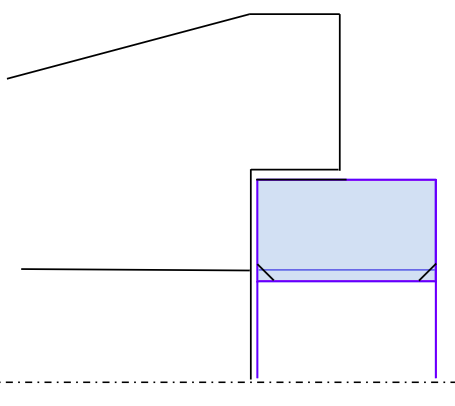
Root cause:
After a full inspection, I found that the space available for chips to clear on the inside is too small. That causes chips to wrap around the tool, and that's what chips the edge. It's the same idea as rush-hour traffic: more vehicles packed into the same space means a higher chance of a collision.
Improvement mechanism:
Either increase the space available for chips to clear, or reduce the volume of chips being generated. Same as the traffic analogy — build a bigger road, or route the traffic so less of it funnels into that one lane.
Solution:
I turned down the back of the chuck to make the space behind it as open as possible. That gives the chips more room, cuts down how much of it wraps around the tool, and the tool chips noticeably less now.
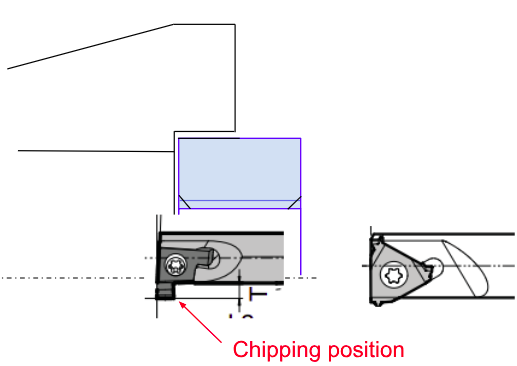
Result:
Before the improvement, the cost items declared in this case ran at $259 per month.
After the improvement, those same items run at $173 per month.
The saving is $86 per month, or $1,037 per year - a 33.3% reduction measured against the cost of the items declared in this case (Consumable), not against the full product cost.
The investment is $27, itemised as 1 entries in the one-off implementation cost table.
The payback time is ~10 days.
Lessons learned:
Chip evacuation in machining matters enormously — not just on the inside of a part, but for every tool you run. I've also written up a separate piece on how chip evacuation affects tool life. Whenever a tool's life cycle looks abnormal or inconsistent, this is worth looking into.
Reusable knowledge
Where this applies:
No real requirement — you just need to know how to turn/machine the chuck. You do need to know how to analyze and work out the "stopper" — the part where the raw stock contacts the chuck — and get that contact area as small as possible.
Risks:
No risk at all.
Author's evidence:
This one is simple: track 5 tool life cycles, before and after, across 5 parts. Run until chipping actually happens. During the tracked period, after machining, do a 100% visual inspection of this spot on every single part. For the "after" cycle, hitting 95% is considered OK.
Reusable idea:
For parts with a similar structure, this should carry over — but I haven't yet applied it to a part with a different structure to confirm.
Tools and materials used in this case
- GER200-010A TN6020 — KYOCERA (TOOL_INSERT_CNMG)