How to get more heat-treat ovens running reliably with preventive and operator-led maintenance
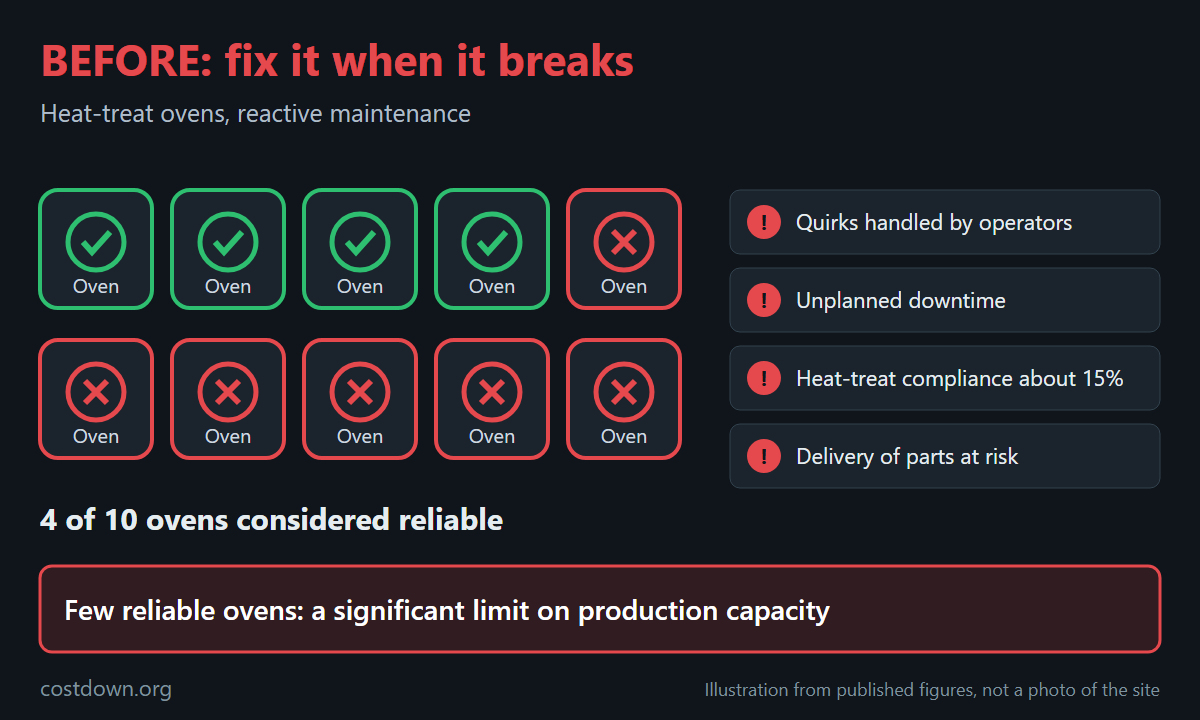
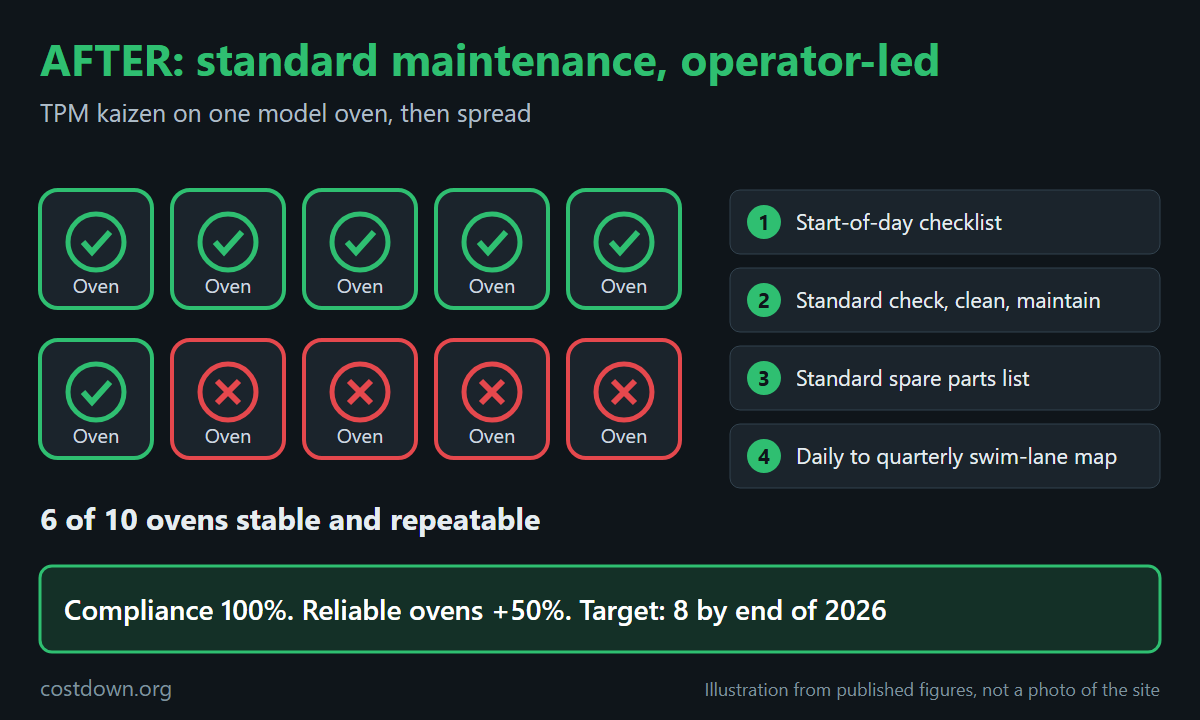
An improvement case in Aviation and Aerospace Component Manufacturing (Heat Treatment), measured results: Heat-treat compliance, Plant 2 oven (before value approximate) 15 → 100 %; Reliable heat-treat ovens out of 10 4 → 6 pieces. Trust level: Unverified.
Measured results
- Heat-treat compliance, Plant 2 oven (before value approximate)15 → 100 %(+567%)
- Reliable heat-treat ovens out of 104 → 6 pieces(+50%)
This case has measurements only, no prices. To see the money saved at your plant, multiply the reduction by your own wage or machine-hour rate.
Current problem:
Lynn has 10 heat-treat ovens. The first one tackled, in Plant 2, heats parts under vacuum up to 2,400 degrees Fahrenheit for brazing or changing metal properties, and feeds several production lines. After decades of use it had quirks that operators worked around, and unplanned stops put delivery of defense engine parts at risk. Before the kaizen, only four ovens were considered reliable, which limited capacity.
Improvement mechanism:
One model cell first. The team picked a high-volume oven, where any stop delays shipments, to build a standard for TPM (total productive maintenance: shop-floor people actively care for equipment and remove losses) before spreading it. Early preparation with operators. Prep began late the previous year, with weekly check-ins with the people running the oven. In early 2026 about a dozen people joined a one-week kaizen. Start-of-day checklist. Every morning now has a list of checks. Standard work. Checking, cleaning and maintenance were standardised, aiming to restore original specifications, make abnormalities visible and cut repairs after failure. Standard spare parts list. Parts that must be on hand were identified so they can be swapped at once. Swim-lane map. Preventive and corrective maintenance steps were mapped by owner, leading to standard daily, weekly, monthly and quarterly activities. Recipes on paper. Much effort went into documenting heat-treatment recipes designed by a metallurgist; some processes run up to 21 hours.
Solution:
GE Aerospace's Lynn site (USA) ran a kaizen around one vacuum heat-treat oven and set up standards for checks, cleaning, maintenance and spare parts. Reliable ovens rose from four to six out of 10.
Result:
The author has not declared any investment for this improvement.
The payback time cannot be worked out. Investment cost not provided yet - payback time cannot be calculated for comparison.
Lessons learned:
Connect maintenance to the people at the machine. Prove it on one cell, spread it, and hold the standard afterwards.
Reusable knowledge
Where this applies:
- A constraint machine that many products must pass through. - Experienced operators get time to take part. - You can take the machine down to restore it and can afford to stock parts.
Risks:
- Results are published by GE Aerospace itself, with no independent check. - The compliance measure is not defined, so do not compare it directly with yours. - An early-year kaizen and a May kaizen on preventive maintenance are both mentioned; it is unclear whether they are one event or two. - No downtime hours, output, spare-part inventory cost or money saved. - Eight ovens by the end of 2026 is a target, not a result.
Author's evidence:
Count ovens that run in a stable, repeatable way and track compliance on the model oven. Also measure unplanned downtime hours.
Reusable idea:
One model machine with a daily checklist, interval standards, a spare parts list and a swim-lane map, then copy to similar machines. How to start in your shop (added by the poster): 1. Pick a constraint machine. Log unplanned stops, hours and reasons for a long enough period. 2. Sit with operators and list the machine's quirks and current workarounds. 3. Write a start-of-day checklist with a named owner. 4. Split maintenance by day, week, month and quarter, with owners. 5. Build a must-stock parts list from failure history. 6. Define a compliance measure clearly, such as tasks done on time over tasks due. 7. Compare downtime with your first measurement before copying to other machines.