How to Achieve CNC Turning Cost Reduction: Eliminating Tool-Change Scrap with a FANUC Custom Macro B, Saving $30,021 a Year
An improvement case in CNC & Precision Machining (Turning): total declared cost down 83%, saving $30,021 a year (savings from: Scrap). Payback in ~2 days on a $136 investment; trust level: Unverified.
ROI is unusually high because the declared investment is very small compared with the monthly saving.
Current problem:
Every plant certified to IATF 16949 or ISO 9001 lives in fear of the first part after a tool change slipping down the line. The usual answer is a clearly labelled quarantine area so operators do not move those parts on by accident. Even so, non-conforming parts still turn up during production, and sometimes at the customer. The investigation that follows - 5 Why or something like it - always lands on the same conclusion: that part was the first one after a tool change. Yet a permanent countermeasure looks close to impossible. Because human error (forgetting) is part of the chain, even Poka-yoke and similar measures cannot remove the root cause completely.
Root cause:
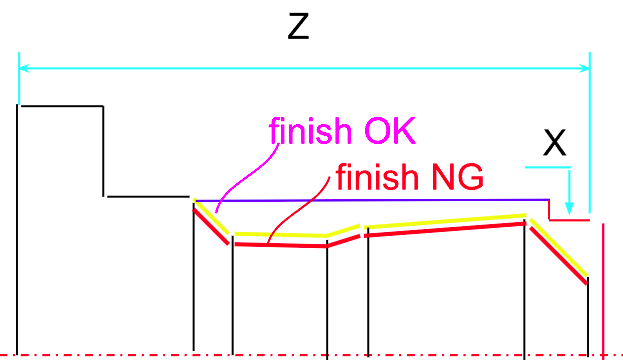
Across the industry, scrap after a tool change is treated as unavoidable, a cost of doing business, like buying fuel to drive a car. Nobody questions it. The real cause is the trial cut. After every tool change, the operator has to cut a test part to confirm the new tool's offset. Because the offset has not been confirmed yet, that trial cut runs right on the boundary between an OK dimension and an NG dimension. So most, often all, of the parts cut right after a tool change end up NG. The scrap is not caused by the tool itself. It is caused by the way the offset is checked.
Improvement mechanism:
When you run 5 Why on this kind of defect, have you ever stopped at a "Why" whose countermeasure is simply: do not produce the bad part in the first place? Most people take it for granted that machining will inevitably generate NG parts - but that is not a law of nature. It is precisely because we assume it is impossible that we stop looking for a solution. A technician, a maintenance engineer or a skilled operator will know the trick of offsetting the tool - shifting it away from the part by a set amount so it never touches the finish stock - and running one trial part after a tool change. The part that comes out is oversize (on an outside diameter) or undersize (on a bore), which means it can be remachined. It works, but done by hand it costs so much time and effort that it is almost never standardised. It took three years of thinking to find a way to make it practical: make the offset happen faster, using automation instead of manual adjustment.
Solution:
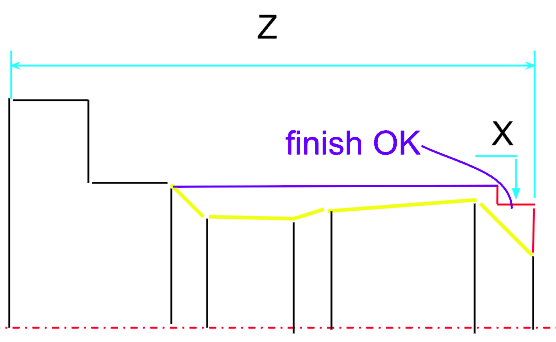
The solution is to let the tool cut only a layer of extra stock first - leaving the part oversize on both the X and Z axes - using a FANUC Custom Macro B program to drive the tool-nose radius offset (for example, writing the value 1 into offset register #2201 for Tool 1). Once that stock pass is done, the part is measured and the offset corrected to target, so the next part comes out at the final finished size. Because the trial part only had its outer layer removed it is not scrap - it goes straight back into raw-material stock to be machined again, which removes tool-change NG parts entirely.
Result:
Before the improvement, the cost items declared in this case ran at $3,002 per month.
After the improvement, those same items run at $500 per month.
The saving is $2,502 per month, or $30,021 per year - a 83.3% reduction measured against the cost of the items declared in this case (Scrap), not against the full product cost.
The investment is $136, itemised as 1 entries in the one-off implementation cost table.
The payback time is ~2 days.
Lessons learned:
Programs like this are genuinely not hard. If you are starting out, take the easiest piece of program first and work up to the harder ones. Once you understand the underlying idea you will find a great many uses for it. It cuts down mistakes made by the operator - it is Poka-yoke at the level of the program, with no fixture needed to do it.
Reusable knowledge
Where this applies:
A CNC machine running a FANUC control (or equivalent) that supports Macro B programming and gives access to the system tool-offset variables. I have also done this on a Mitsubishi control.
Risks:
An operator entering the wrong value for the variable - handled by standardising the entry down to a single easy value, 1, in register #2201, so it is easy to remember. Which means you have to produce a work instruction sheet, and train people on it. Senior management has to make production feel this improvement is worth doing, because it is a genuinely new way of working - nobody has done it before. If your company does not care about cutting even 2 bad parts per shift, you will not get this off the ground.
Author's evidence:
Stock retained: the trial part machined in the extra stock still has enough material left to be finish-machined again. Defects removed: NG parts caused by tool changes drop to zero. Cost saved: $2,502 a month ($30,021 a year) on this product line, as shown in the cost table above.
Reusable idea:
There are a great many ideas you can apply with this way of programming by macro. There is almost no limit, as long as you can think of it. Here are a few things I have actually done: - Instead of adjusting one tool in Z and then adjusting the others by hand, the others follow automatically. - Offsetting along a diagonal path to compensate for the tool being pushed away by cutting force. - Adjusting at any chosen stage within a tool's life cycle. - Timing how long a section of program takes to run, so you can verify how much a program change actually gained.