How to Achieve CNC Turning Cost Reduction: A 3-Point Collet Contact Design Cuts Lathe Length Defects by 66.6%, Saving $45,070 a Year
An improvement case in CNC & Precision Machining (Turning): total declared cost down 61%, saving $45,070 a year (savings from: Scrap). Payback in ~1 days on a $136 investment; trust level: Author-evidenced.
ROI is unusually high because the declared investment is very small compared with the monthly saving.
Current problem:
The turning operation has to hold a length tolerance of 15 ± 0.06 mm. The NG rate ran at 0.2% - one bad part in every 500. The plant runs 5 similar high-volume part numbers, 725,000 pieces a month in total.
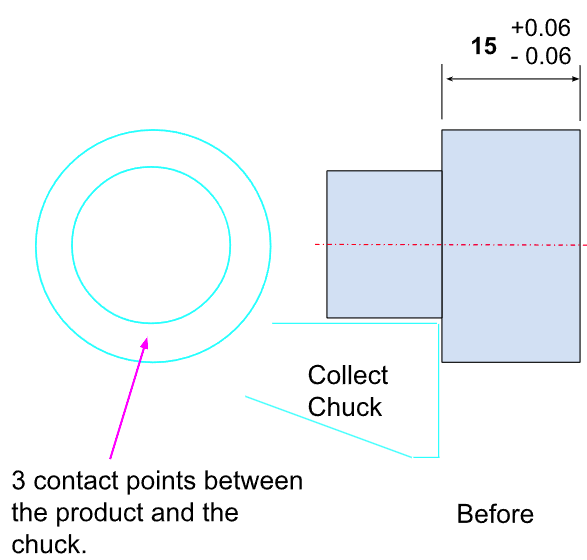
Root cause:
The analysis showed the length deviation came from the part not seating fully in the collet chuck, driven by three causes: - Chips sticking to the contact face (a chip only 0.07 mm thick is enough to push a part out of tolerance) - Operators tiring and losing focus towards the end of a shift - A full-circle contact face, which gives chips more surface to lodge on. Measurement data showed 100% of the bad parts were undersize (< 14.94 mm), confirming the deviation always went the same way.
Improvement mechanism:
- Reduce the chance of a chip sitting between the chuck and the part - Find a way to set up the lathe's chuck arrangement so it produces fewer NG parts even when the operator is tired at the end of a shift.
Solution:
- Redesign the clamping face: replace the full-circle contact with a 3-point contact design (3 mm x 3 mm per point) - Contact area drops to about 20%, and the chance of a chip sticking drops by 80% - Add an air blast aimed directly at the contact area to keep it clean - Limit the chuck opening stroke to just 0.2 mm over the blank diameter (with a C1 chamfer) - Shift the target centre dimension upward (15.01-15.03 mm) so the deviation is balanced on both sides. Length defects fell from 0.2% to 0.04% across 5 turned part numbers by applying the 3-point chuck contact design, controlling the chuck stroke, and shifting the target machining centre dimension.
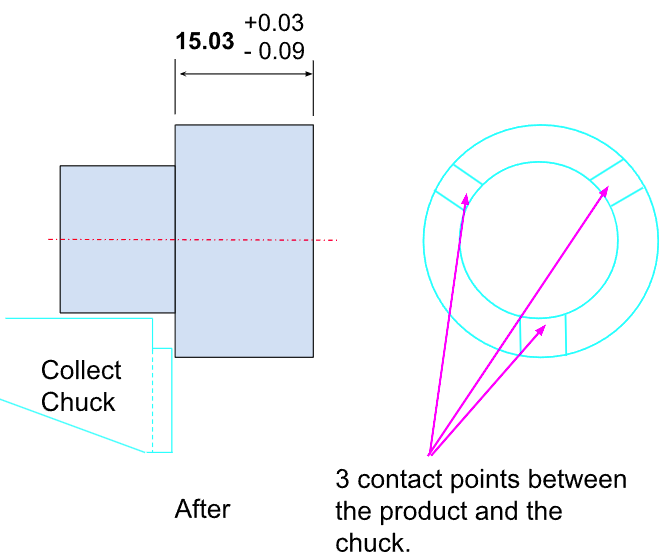
Result:
Before the improvement, the cost items declared in this case ran at $6,143 per month.
After the improvement, those same items run at $2,387 per month.
The saving is $3,756 per month, or $45,070 per year - a 61.1% reduction measured against the cost of the items declared in this case (Scrap), not against the full product cost.
The investment is $136, itemised as 1 entries in the one-off implementation cost table.
The payback time is ~1 days.
Lessons learned:
- Do not be afraid to shift the axial dimension of the part (the Z direction on a lathe) to ONE side rather than to nominal. That is the key. - Do not be afraid to cut a relief groove 1-2 mm deep where you can. I first tried only 0.2 mm and the effect was very weak - probably because the chips are much larger than that.
Reusable knowledge
Where this applies:
Applies to turning and milling operations using a collet chuck or a fixture that locates on the end face.
Risks:
Clamping force concentrated on small 3 mm x 3 mm points can dent the surface of a soft blank if the surface hardness or the clamping pressure is not set correctly.
Author's evidence:
Track the daily and weekly scrap-rate report before and after the change. Plot the length distribution and calculate process capability (Cpk) over 100 consecutively run samples to confirm the distribution now sits balanced within tolerance.
Reusable idea:
Any dimension in the Z direction on a lathe where the bad parts are caused by the operator.